
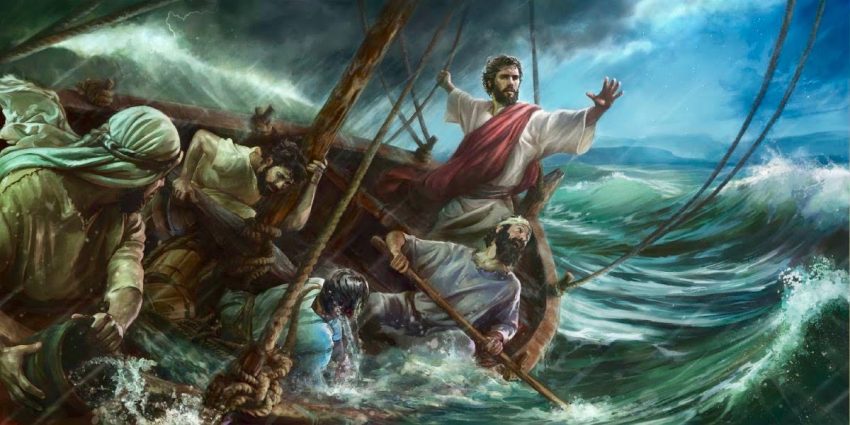
Mark 4:35–37 (NKJV) – “On the same day, when evening had come, He said to them, ‘Let us cross over to the other side.’ Now when they had left the multitude, they took Him along in the boat as He was. And other little boats were also with Him. And a great windstorm arose, and the waves beat into the boat, so that it was already filling.”
When Jesus invited His disciples to cross the sea, the storm came mid-journey. The call to move forward in faith often stirs opposition. Progress and purpose attract resistance. Theologically, storms are not always signs of failure; sometimes they confirm direction. Job’s suffering, Paul’s shipwreck (Acts 27), and even Jesus’ temptation (Matt. 4:1) came in moments of divine assignment. The sea-crossing teaches us that turbulence is often the prelude to testimony.
Yet Christ was present in the storm. His calmness rebuked fear and revealed His authority: “Peace, be still!” (Mark 4:39). The storm became a classroom where faith matured and power was displayed. As Augustine noted, “God does not promise an untroubled sea, but a safe shore.” Your storms are not signs of abandonment but opportunities to witness His strength.
Therefore, do not dread the winds that rise when you step into new territory. Crossing over often leads to new victories—the demoniac was delivered on the other side (Mark 5:1–13). Trust the One in your boat. Psalm 46:1 reminds us, “God is our refuge and strength, a very present help in trouble.” The storm cannot sink a vessel carrying His purpose.
Further readings:
Psa. 46:1–3
Isa. 43:2
Acts 27: 21-25
🙏 Blessed Day 🙏